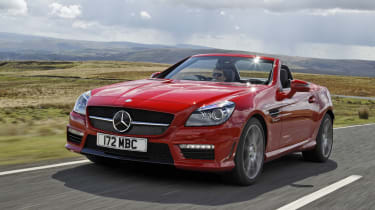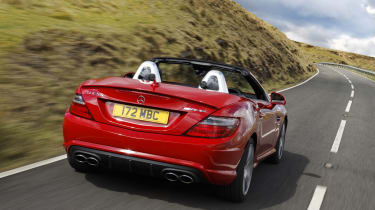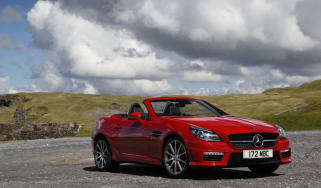
"The Mercedes SLK roadster is a great car for fun in the sun, with a responsive engine, comfortable ride and classy interior."
At a glance
- The greenest
- SLK 250 CDI Auto 2dr
£32,615 - The cheapest
- SLK 200 2dr
£30,345 - The fastest
- SLK AMG 55 2dr
£55,335 - Top of the range
- SLK AMG 55 2dr
£55,335
Sponsored Links
Now a couple of years old, the latest version of the famous Mercedes SLK luxury roadster focuses more on comfort than performance, making it a rival for the BMW Z4. However, you’re still likely to find that the 1.8-litre turbo petrol engine produces an exhilarating amount of acceleration and speed. Most road bumps and holes are ironed out by the suspension, but switch the SLK to Sport mode and it stiffens up to improve cornering performance. You can choose from a range of four and six-cylinder engines, with this third generation marking the first diesel engine to be available in the SLK. Meanwhile, the exterior has taken some design elements from the Mercedes SLS to offer a more stylish look. Inside, good quality abounds, with the optional Magic Sky Control roof being the highlight, with its special glass that allows the driver to adjust the level of transparency. So, in the summer you can make it darker (and therefore cooler) or let in more light when the sky is overcast to make the interior feel airier. That's as close as you’re going to get to controlling the British weather!
Drive
The third-generation SLK is the best to drive yet, but it's steering and an occassionally bumpy ride does prevent it from truly taking on key rivals like the Porsche Boxster. It grips well enough and the suspension is soft over bumps, but it stiffens up to make cornering easier. There are four punchy and responsive petrol engines and one diesel to choose from, starting with the four-cylinder 184bhp SLK 200, which comes with a six-speed manual gearbox or an efficient 7G Tronic automatic. Move up to the six-cylinder 350 version and bhp increases to 306. If performance is paramount, the 415bhp 5.5-litre SLK 55 AMG will more than do, but it's worth noting that even the 2.1-litre diesel offers 200bhp and can go from 0-62mph in 6.7 seconds. The best balance of speed and efficiency is the 201bhp 3.5-litre V6, which also makes a pleasing sound that can be enhanced by a fun feature that allows you to have specific engine sounds piped into the cabin.
Comfort
The SLK cabriolet is definitely pitched more towards comfort than the outright sportiness of the Porsche Boxster, which makes it more in line with the BMW Z4. On the plus side, that means the ride is smooth enough to make cruising a joy, with the interior also being roomier than the model it replaces. If you use the Sports suspension, the ride is a lot firmer, however. And don’t underestimate how brilliant the optional Magic Sky Control sunroof really is – the ability to darken the interior when the sun is beating down is very useful. It can even cut out the need for air-conditioning. There's also hardly any wind or road noise inside. Fold the roof down and it's still very calm to drive, with hardly any draught, and if you opt for the Airscarf, little heating vents built into the seats warm your neck and virtually eliminate wind chill factor. Visibility is generally excellent, although the rear view is somewhat restricted when the roof is in place thanks to a small rear window, which can make parking a bit tricky.
Reliability
One thing you can definitely rely on with Mercedes is that build quality will always be high, so everything inside and out on the SLK feels well screwed together. Mercedes was also voted the fifth most reliable manufacturer in the 2013 Driver Power UK customer satisfaction survey, so you can expect good reliability. Safety-wise, the previous SLK received four stars in the Euro NCAP crash safety tests, and we expect the third generation model to perform even better thanks to a variety of safety systems, including attention assist to monitor driver alertness, an active bonnet to reduce injury to a pedestrian in the event of a crash and a crash anticipation system that prepares all the safety systems if a possible impact is detected, including pre-tension seatbelts. And for more money, you can also add brake assist, speed limit assist, lane keep assist and Distronic Plus, which matches your speed to the car in front – very handy on the motorway.
Practicality
A two-seater convertible is never going to be as practical as a family hatchback. However, when the roof is up the boot offers 335 litres of luggage, which is 25 litres more than in the BMW Z4, and – amazingly – more than a Ford Focus. It also has a twin-height boot floor that makes storing bulkier items easier. With the roof folded, the space is cut to 225 litres, which is still more than most of the SLK's rivals, who lose far more space when their roofs are down. Inside, there's lots of space for a two seater's limited dimensions and noise is minimal, while visibility is good (except through the back window) and it's easy to get comfortable.
Value for money
Open-top motoring is a luxury that's outside of most people's price range, with list prices for many convertibles in line with some executive saloons. But in relative terms, the SLK is competitively priced compared to the BMW Z4. You get LED bumper lights, alloy wheels and a folding metal roof as standard, while AMG Sport models get a sportier body kit, larger alloy wheels, leather sports seats and tinted front and rear lights. Just be careful when going through the options list, as they can make the price spiral up pretty quickly – the Magic Sky Control roof, for instance, will leave you £2,000 less well off. If you add a lot of extras, the SLK starts to become less value for money than its rivals.
Running costs
Stop-start fuel-saving technology and efficient gearboxes comes as standard on SLKs. The four-cylinder 2.1-litre diesel engine performs the best, returning 56.5,pg and emitting 132g/km of CO2. But fuel efficiency is fairly decent on the petrol models, too, returning 45.6mpg with reasonable emissions of 144g/km. This means that it is cheaper to run overall than a BMW Z4, but the petrol engines are naturally costlier, while the automatic gearboxes are marginally more efficient.