Nissan Leaf hatchback review
“The Nissan Leaf has been around for a while, but a spacious cabin, larger battery and affordable price help it keep pace with newer rivals”


Pros
- Improved driving range
- Good value for money
- Easy to live with
Cons
- Some cheap plastics
- Less distinctive looks
- Slightly firm ride
Verdict – is the Nissan Leaf a good car?
A mainstream EV stalwart, the Nissan Leaf has stood the test of time thus far and even manages to keep up with contemporary rivals in many respects. While its interior may feel a bit drab compared to flashier and more tech-focused cabins, the Leaf offers more space than several other electric hatchbacks while also undercutting them on cost. Range and charging speeds on the base model lag behind rivals, though, and with the arrival of the newer and even cheaper MG4, only time will tell whether the Leaf can maintain its evergreen appeal.
Nissan Leaf models, specs and alternatives
The original Nissan Leaf made its debut all the way back in 2010 and was, up until 2018, the best-selling electric car in Europe. Now in its second generation, the Leaf is an electric family hatchback that’s since been joined by rivals such as the competitively-priced MG4 and Citroen e-C4, as well as more expensive offerings such as the Volkswagen ID.3 and Cupra Born.
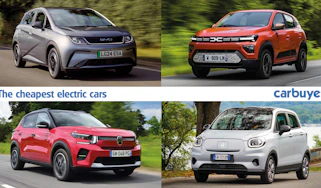
 The 10 cheapest electric cars you can buy today
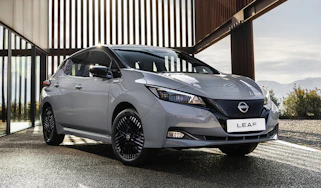
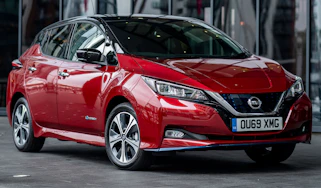
Unlike the larger Nissan Ariya SUV which adopts a bold and stylish design, the Leaf is much more understated, with very little to distinguish it from run-of-the-mill petrol hatchbacks like the Ford Focus. This is international, however, as Nissan has designed the Leaf to ‘normalise’ electric motoring – those looking for something that feels a bit more revolutionary may be better suited to something like the hi-tech Renault Megane E-Tech.
More reviews
In-depth reviews
Road tests
Used car reviews
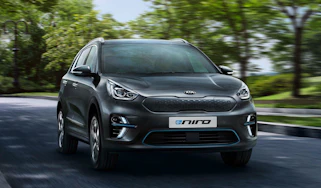
Nissan offers the Leaf with two battery configurations: the standard 40kWh model and the 62kWh ‘e+’. Even entry-level Nissan Leafs are claimed to be able to achieve 168 miles on a single charge, while the e+ claims a range of 239 miles. This is 25 miles more than the similarly-priced Peugeot e-2008, but behind that of the 280 miles offered by the Kia Niro EV – although this is much more expensive than the Leaf.
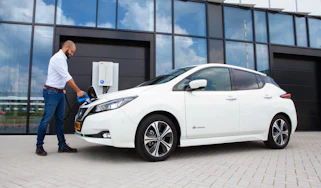
It’s a shame, however, that the standard Leaf is only compatible with charging speeds of up to 50kW; the top-of-the-range e+ gets 100kW charging, allowing for a 10-80% top up in around half an hour when connected to a compatible public charger.

All versions of the Nissan Leaf are front-wheel-drive, yet a pair of powerful electric motors offer brisk performance. The standard Leaf utilises a 148bhp motor, getting from 0-62mph in 7.9 seconds – over 1.5 seconds quicker than the equivalent Renault ZOE. The e+, on the other hand, gets an even more powerful 214bhp motor, reaching 62mph in a hot hatch-rivalling 6.9 seconds.
One of the main attractions to the Leaf is its price – starting from under £30,000, it’s much cheaper than most other electric family hatches, bar the aforementioned MG4. Despite this, however, even the base Acenta model comes with a full suite of safety kit including blind spot monitoring and lane-keep assist, as well as 16-inch alloy wheels, a reversing camera and an eight-inch touchscreen with Apple CarPlay and Android Auto. Mid-spec N-Connecta adds a Tech Pack, which includes systems to make jobs like parking easier, heated seats and tinted windows, while top-spec Tekna offers LED headlights, a Bose audio system, even more safety kit and part-leather upholstery. It’s worth noting that the e+ model is only available with the N-Connecta and Tekna trims.
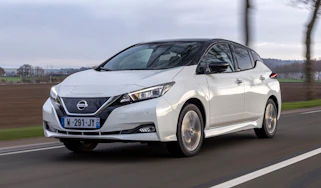
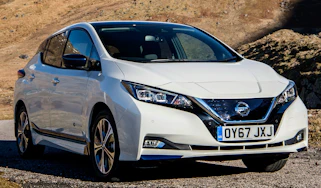
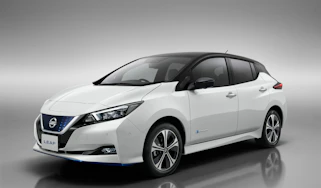
In mid 2023, Nissan introduced a special edition Shiro model, based on N-Connecta trim, to the Leaf range. ‘Shiro’ means white in Japanese, and these cars are available in an Arctic White paint scheme or optional two-tone Storm White with a Pearl Black roof. We think it’s worth considering the Shiro if you’re looking at N-Connecta trim cars, given it’s actually £2,000 less than that specification – as long as you’re not fussed at the lack of more vibrant paint options.
The original Leaf was the first electric car to score five stars in Euro NCAP crash-testing, and its successor has managed to repeat the result. That’s even more impressive given how much tougher the test has become in recent years. The Leaf could only muster 63rd out of 75 cars in our 2022 Driver Power owner satisfaction survey, though, with owners praising the car’s low running costs but picking holes in its reliability – 23.5% of owners reported a fault with their car, which might be a cause for concern.